
Creating to Resist: The Power of Art in the HIV Response

Art does not exist merely to be admired. It also exists to challenge, expose, and transform.
By Liaam Winslet | Rio de Janeiro, Brazil | #AIDSSociety #AIDS2026
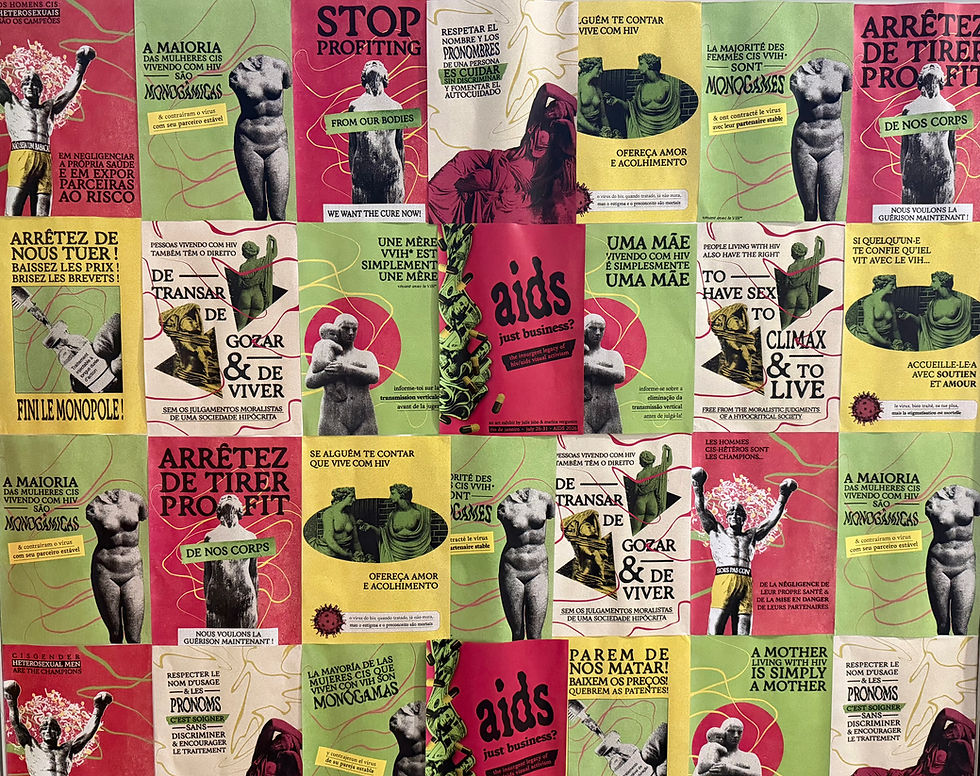
Aids just business? The insurgent legacy of hiv/aids visual activism an art exhibit by Julie Lobo & Marina Vergueirorio de Rio de Janeiro • july 26–31 • AIDS 2026
Throughout the history of the HIV response, science has rightfully earned recognition for transforming what was once a fatal disease into a manageable chronic condition for millions of people. Yet to tell this story solely through the lens of medical breakthroughs is to overlook those who, long before effective treatments existed, used art, creativity, and collective action to demand nothing less than the right to live.
HIV has never been only a biomedical challenge. From the very beginning of the epidemic, it has also been a human rights crisis, a struggle against stigma, and a reflection of the profound social inequalities that continue to shape our communities. Within this context, art evolved from an aesthetic practice into a powerful form of resistance.
A conversation exploring the relationship between art, activism, and HIV reminded us of the political power of artistic expression: its ability to reveal what fear, prejudice, and silence kept hidden for decades.
Art as a Tool for Survival
The first generations to confront the epidemic understood that survival meant far more than simply staying alive.
At a time when scientific knowledge was limited and institutional responses were inadequate, communities organized themselves, shared information, and built networks of mutual support. Creativity became an essential part of that response.
Posters, photography, performance art, poetry, and exhibitions became instruments for confronting discrimination, demanding access to treatment, and preserving the memory of those who were lost.
This history also honors activists who fought for early access to antiretroviral therapy in Brazil, demonstrating that many of today’s medical advances were made possible by the relentless advocacy of organized civil society.
Provocation Is Also an Act of Care
One of the most compelling ideas to emerge from the discussion challenged conventional notions of art: provocation can also be an act of care.
Political provocation is not about creating controversy for its own sake. It is about breaking silence, challenging dominant narratives, and compelling society to confront realities it would rather ignore. Within the context of HIV, provocation means questioning stigma, confronting prejudice, and creating space for conversations that have been considered uncomfortable for far too long.
The most powerful artistic interventions have been those that carried HIV beyond hospitals and clinics into streets, museums, public spaces, the media, and ultimately into public consciousness.
Surviving Is Not the Same as Living
One of the discussion’s most powerful messages was the distinction between surviving and living.
While scientific advances have made it possible for many people living with HIV to enjoy life expectancies comparable to those of the general population, countless individuals continue to experience social exclusion, discrimination, mental health challenges, and violence.
The virus may be medically controlled, but stigma continues to shape employment opportunities, family relationships, intimate lives, and emotional well-being.
Silence remains one of the most persistent forms of violence. Many people still hide their HIV status out of fear of rejection—even within their own families. This reality reminds us that the HIV response still faces enormous challenges beyond clinical care.
The Family That Chose to Stay
In the face of institutional neglect and family rejection, communities emerged that many people now recognize as the true family of HIV.
These were not always families connected by blood, but by an unwavering commitment to care for one another. They listened, organized collective responses, provided support, and created hope when fear seemed overwhelming.
These communities remain essential because they remind us that the HIV response has never been solely about medicine. It has always been deeply rooted in community.
Breaking the Bubble
Another critical challenge raised during the conversation was that discussions about HIV too often remain confined to those who are directly affected.
The response must move beyond that bubble.
Ending stigma requires engaging people who do not live with HIV, along with journalists, artists, educators, cultural institutions, and policymakers. Prevention, empathy, and social justice can only be achieved when society as a whole becomes part of the conversation.
Meaningful partnerships matter far more than symbolic gestures. Solidarity cannot be reduced to a social media campaign; it must translate into concrete actions that expand rights and reduce inequality.
A New Way of Telling the Story
The discussion also invited participants to rethink how HIV is visually represented.
For decades, images associated with the epidemic were dominated by suffering, illness, and death. Without erasing that painful history, there is now an opportunity and a responsibility to create new visual narratives that also reflect community, diversity, creativity, resilience, and life.
The goal is not to rewrite history, but to broaden the way we tell it, ensuring that new generations understand HIV is not simply a chapter in history books. It remains a daily reality for millions of people around the world.
Memory Is Also a Political Act
There is always a risk of turning the history of HIV activism into something to be admired from a distance preserved in museums while stripped of its transformative power.
That is why the discussion argued that art connected to HIV must remain committed to memory and social justice. It cannot be reduced to decoration or transformed into a commercial commodity. Its true value lies in reminding us that every scientific breakthrough, every treatment now available, and every right that has been secured exists because people chose to raise their voices when doing so meant challenging power.
More Than an Exhibition
Art exhibitions, cultural spaces, and creative interventions offer an opportunity to reopen conversations that should never have been allowed to fade.
Art reaches places where institutional campaigns often cannot. It creates empathy, sparks difficult questions, and builds emotional connections with people who may have never encountered HIV in their own lives.
At a time when science continues to advance while stigma persists, reclaiming the political power of art has never been more urgent.
Because the history of HIV is not written only in laboratories or scientific journals.
It is also written in murals, photographs, poems, performances, posters, and exhibitions that refuse to allow silence to replace memory.
And as long as even one person feels compelled to hide their HIV status out of fear of rejection, art will continue to have an unfinished mission: to remind us that the true response to HIV does not end with treatment. It begins when society chooses to truly see those who have been marginalized for far too long and recognizes that dignity, memory, and justice are themselves essential forms of health.


Comments